The words behind your brand and website, drawn out.
Choose a topic below to begin. Tap anything to see what it is, where it lives, and why it matters for your project. We'll use a sample client, Juniper Hall, a certified life coach, so you can see every piece in action.
If your website were a house
These six words get mixed up more than any others. Picturing a house makes the difference clear.
Website
The whole place people visit: every page, word, photo, and button.
Yours is built on Squarespace.
Domain
What people type to find you, like juniperhall.com. You rent it by the year.
We register it inside Squarespace so your address and your house live together.
Hosting
The computers that store your site and keep it open day and night. You never see it, but without it the house has nowhere to stand.
Included in your Squarespace plan. Nothing extra to buy.
Design
How it looks, how it's laid out, and how people move from room to room. Colors, fonts, spacing, and flow.
This is the part I create for you.
Coding
Written instructions (HTML and CSS) that tell a web browser how to build what you see on screen.
Squarespace writes most of this for us. I add custom code only for special features.
Programming
The logic that makes things do something: a form that sends, a calendar that books, a cart that checks out.
Built into your platforms, so it works without anyone writing it from scratch.
You'll often hear coding and programming used as if they mean the same thing. For your project, the simple version is this: design is how it looks, and code is what makes it show up and work.
The parts of a page
Choose a word to see where it lives, or tap any part of the Juniper Hall sample site.
Your next chapter starts here
Warm, practical life coaching for women ready for a fresh start, a new season, or simply more room to breathe.
Start with a free callhello@juniperhall.com
Coaching
Privacy policy
Hosting isn't on the page anywhere. It's the ground underneath all of it.
Every page has a job
A page is one screen of your site with its own link in the menu. Each one should do one job well.
Home
A quick overview of who you help and how, with clear paths to the other pages.
About
Your story, your values, and why you're the right person. It's really about the client, told through you.
Services
What each offer includes, who it's for, where pricing starts, and how to book.
Contact
Your inquiry form, plus any booking link or location details. This is where the CRM form lives.
Blog
A running collection of articles. Each post is its own page that Google and AI tools can find.
Sales or landing page
A focused page for a single thing, like a workshop or free guide. Often left out of the menu and shared by link.
How your website, CRM, and email connect
Integration simply means two programs are connected, so information moves between them without anyone copying and pasting.
The front door
Where people find you and reach out. It collects information but doesn't keep it.
The office
Where clients live: inquiries, questionnaires, proposals, contracts, and invoices. HoneyBook is a CRM.
The mailroom
Where your list lives and newsletters and automatic emails go out. Flodesk is an email program.
The key idea: the form on your website usually belongs to your CRM or email program. It's placed on your page with a small piece of embed code, like a window into that program. When someone clicks Send, their information goes straight to that program, not into your website.
SEO and AIEO
Both are about being found. The difference is where people are looking.
SEO
Setting up your site so Google and other search engines understand it and show it when people search for what you do.
What helps: page titles, descriptions, headings, image names, fast pages, and a Google Business Profile.
AIEO
Setting up your site so AI tools like ChatGPT, Claude, and Google's AI answers can understand you, trust you, and recommend you by name.
What helps: clear answers to common questions, consistent details everywhere you're listed, and copy that plainly says who you help and where.
A brand is built in layers
Your logo is the part people see first, but it sits on top of three layers of thinking. We build from the bottom up.
Brand strategy
The plan. Who you are, what you offer, how you're different, and where you're headed.
Juniper Hall helps women in a new season of life move forward with practical, personal coaching.
Brand audience
The people you're for: their needs, worries, and where they spend their time.
Women 35 to 55 facing a career change, an empty nest, or a fresh start.
Brand messaging
What you say and how you say it: tagline, key phrases, and tone of voice.
Tagline: Every day is a new opportunity. Voice: warm, hopeful, and grounded.
Brand identity
How your brand looks: the logo family, colors, fonts, graphics, and photos.
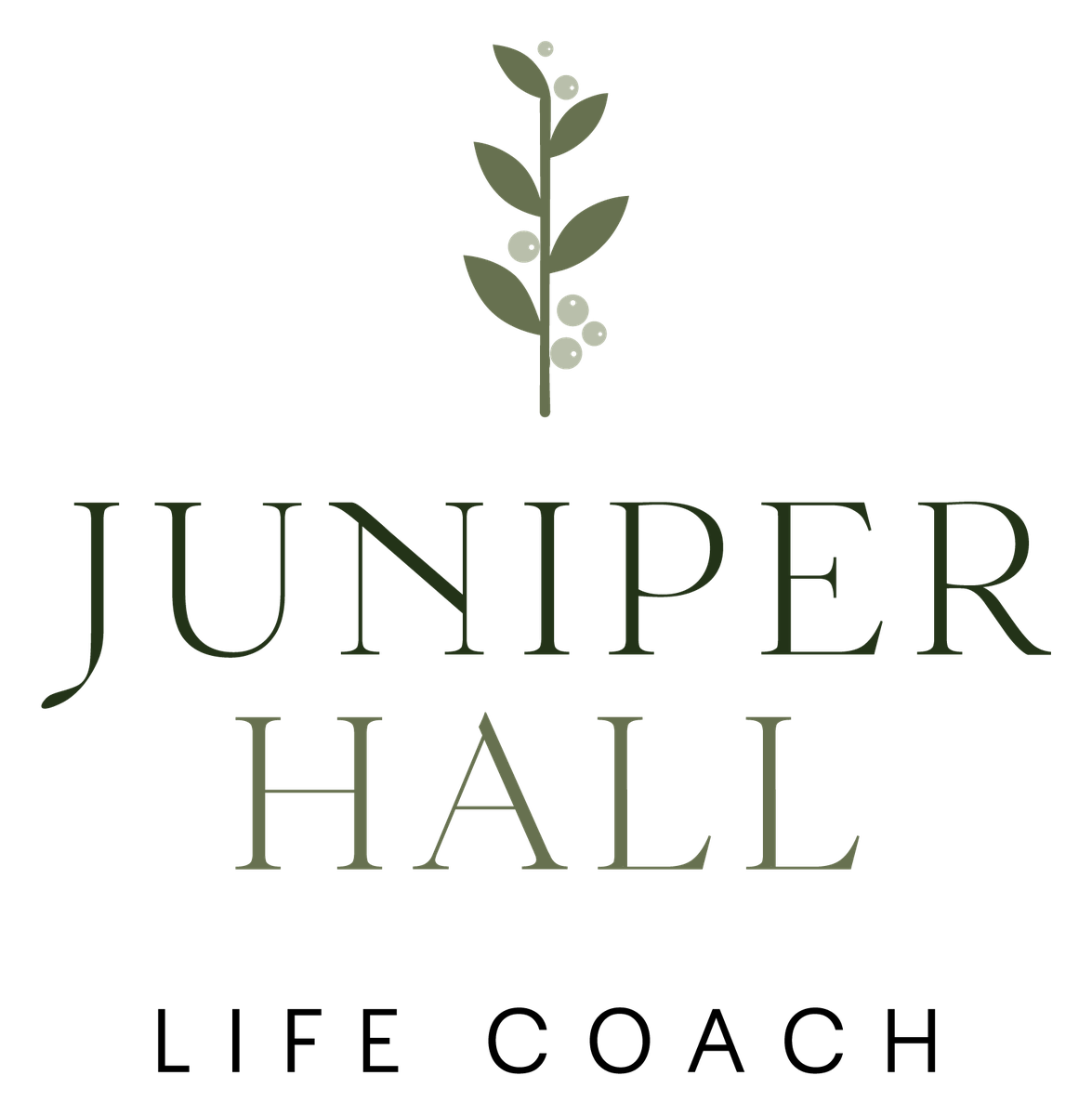
A juniper sprig, evergreen and sage, classic serif capitals, and a handwritten script.
Identity is what people see. Strategy, audience, and messaging are why it looks that way.
The logo family
Your identity includes many marks. They work as a family, and each one has a specific role.
You have one logo. Everything else supports it.
Your primary logo is your logo. The secondary logo, wordmark, and icon are the same logo rearranged to fit different spaces. The monogram, stamp, seal, and favicon are accent marks: small finishing touches, like initials on stationery, not a second logo.
Your logo
One logo, arranged four ways
Primary logo
Your full, main logo with every element together.
Where: your website, business cards, signage, anywhere there's room.
Secondary logo
The same logo, rearranged side by side instead of stacked.
Where: your website header, email signature, wide and short spaces.
Wordmark
Just your business name in its special lettering. No symbol.
Where: document headers, merchandise, places a symbol would crowd.
Icon (brandmark)
The symbol from your logo, on its own, without words.
Where: social media profile photos, app icons, small spaces.
Accent marks
Finishing touches that add personality. Never a replacement for your logo.
Monogram
Your initials, designed together as one decorative mark.
Where: note cards, stickers, packaging, the back of a business card.
Stamp
A round badge with words wrapped around a center mark.
Where: stickers, product labels, social graphics, website accents.
Seal
A mark styled like a wax or embossed seal, for a finished, official feel.
Where: envelopes, certificates, gift packaging, thank-you cards.
Favicon
A tiny square icon shown in the browser tab and bookmarks.
Where: only on your website, at about the size of a fingernail.
Supporting graphics
Decoration that makes everything feel like you
Illustrative designs
Small drawings in your brand's style that add warmth and help explain ideas.
Where: service sections, social posts, workbooks, packaging.
Pattern
A repeating design made from your brand elements.
Where: backgrounds, tissue paper, the back of business cards, slide borders.
Signature phrase
Your tagline set in a handwritten script, used like a signature.
Where: social graphics, the end of emails, printed notes.
The rules that tie it together
What makes everything look like it belongs to the same family
#243519
#677150
#B9BFAB
#ECEFE6
#D9B6A1
#454942
Color palette
Your set of brand colors, each with exact codes so they match everywhere, on screen and in print.
Fonts and typography
The typefaces you use and the job each one does: headlines, paragraphs, and small accents.
Photography style
Guidelines for how every photo should look and feel, so your images match even when they come from different places.
- Soft, natural light, often golden hour
- Real moments and details, not posed portraits
- Hands, textures, doorways, and open landscapes
- Deep greens with warm, creamy neutrals
Where each mark shows up
Scroll to see the family at work
How to read your brand presentation
Your presentation shows one piece of the family per page. A mark shown alone on its own page is one part of the system, not a new logo option.
Name that mark
Seven quick questions to lock it in. Nothing is scored or saved; it's just for you.
What is this?
Still have a question?
Bring it to our next call. There are no silly questions here, and knowing these words makes every decision on your project easier.
Juniper Hall is a sample brand created for this guide.